That Excel File Mike Built in 2013
AI will replace everything. Except the load-bearing spreadsheet nobody understands, nobody can touch, and the entire reporting cycle runs through.
The meme is funny because it's true.
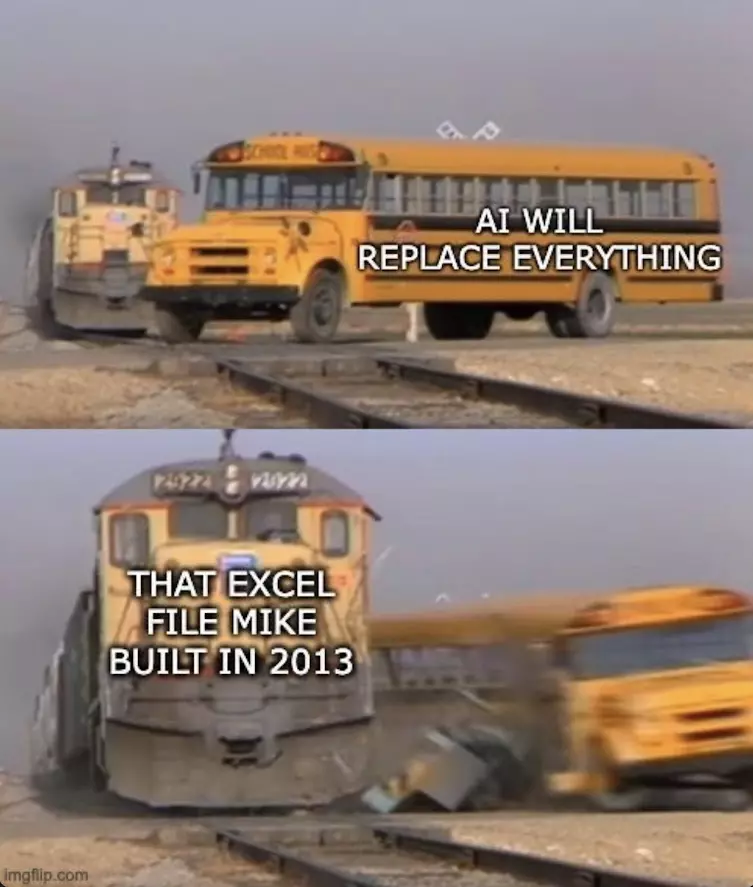
AI will replace everything. Except that Excel file Mike built in 2013 that nobody understands, nobody can touch, and the entire reporting cycle runs through.
There are thousands of Mikes. I was one of them.
The argument
Companies have always been bad at innovation. Not because smart people weren't trying — but because the people trying were building in the margins, without resources, without air cover, and without any path to making their work official. AI just handed those people a completely different kind of leverage. The question is whether your organization will let them use it.
We Were Already Building the Infrastructure. We Just Didn't Call It That.
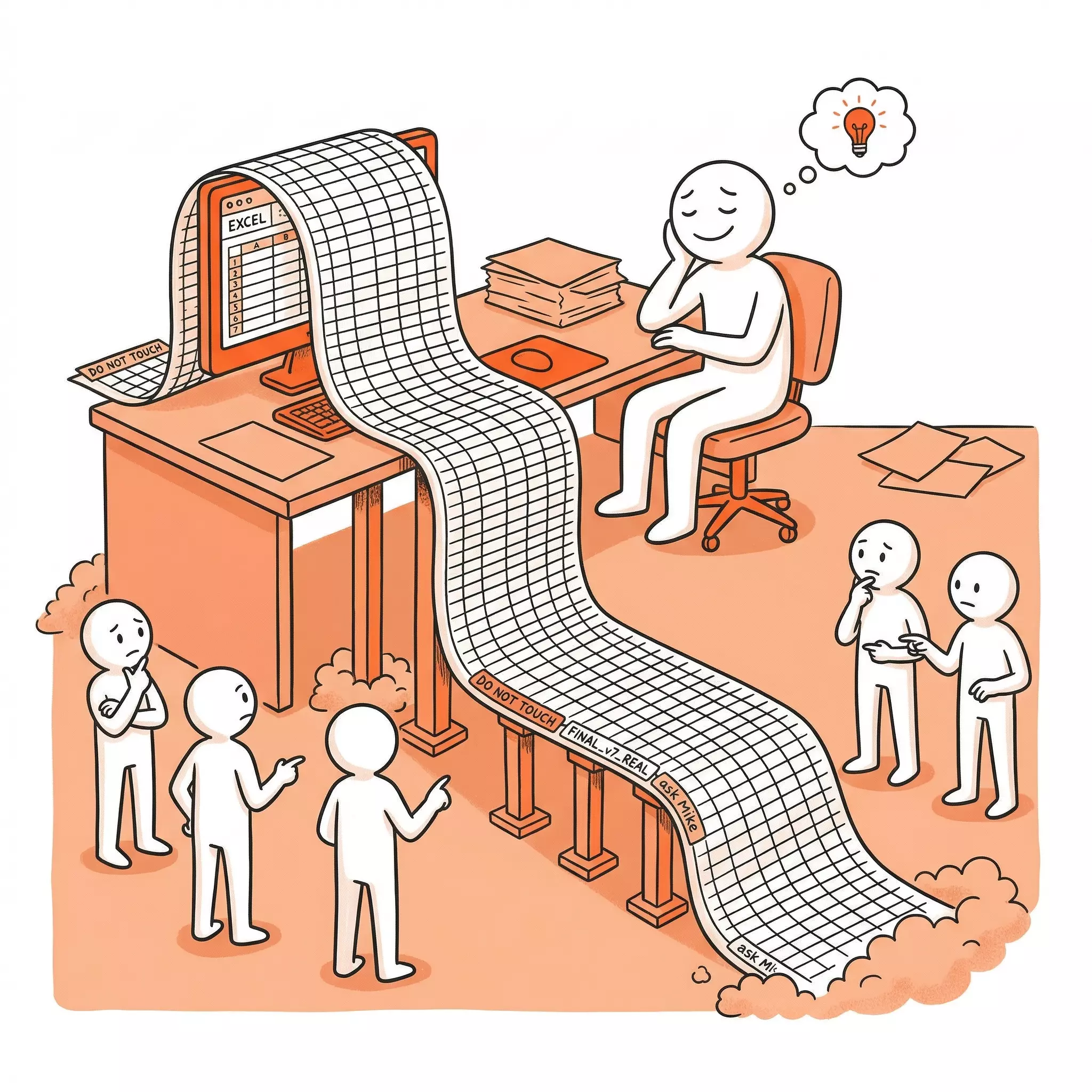
For years, the real innovation inside most companies didn't come from IT. It came from people like Mike — operators, analysts, finance leads, operations managers — who got tired of waiting and built things themselves. Excel models with macros. CSV pipelines stitched across three systems. Custom reporting processes that one person knew how to run and another person inherited without documentation.
In most companies I worked in, IT meant helpdesk support. Getting actual software approved meant convincing your director to allocate budget, then waiting months for a security review, then watching the project dissolve in a committee. Asking IT directly meant a significant engagement, a project manager, and enough bureaucracy to outlast your tenure.
So people like Mike stopped asking. They built.
I did it too. I built entire parallel processes on top of broken systems and maintained them personally, hoping that someday IT would formalize them. Sometimes they did. Most of the time, those processes just became load-bearing infrastructure that no one wanted to touch — because touching them meant breaking something no one fully understood anymore.
Before We Go Further — A Quiet But Serious Problem.
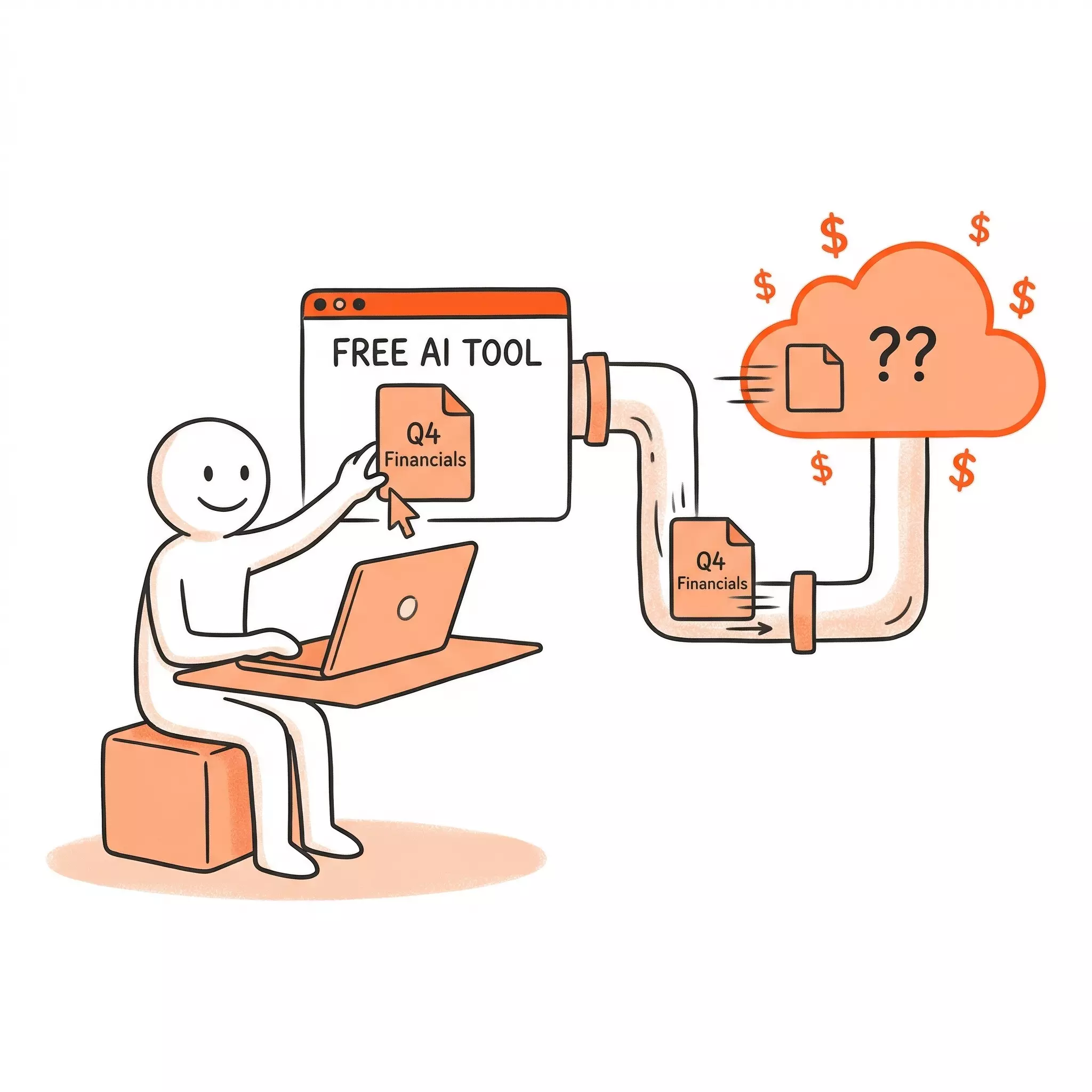
If you're uploading spreadsheets to AI tools right now to get around this bottleneck, stop and ask one question first: where is that data going?
Most "free" AI tools are not free. Your data is the product. Uploading a financial model, a customer list, or an operational process to an unvetted platform is not a workaround — it's a liability. The urgency to move fast on AI is real. But the people who will regret it most are the ones who didn't pause here.
That note belongs near the top of every AI conversation in your organization. Now back to the argument.
Bureaucracy Is Not Incompetence. It's an Immune System.
The CFO, Legal, HR, IT — they're not obstacles because they're bad at their jobs. They're obstacles because their jobs are to maintain order. They are, structurally, agents of stability. And stability and innovation are not compatible at the same speed.
That's not a criticism. An organization without that immune response would fail differently — chaotic, unscalable, exposed. The problem isn't that the function exists. The problem is that no one ever built the interface between the innovation layer and the stability layer.
So everything that didn't fit the process either died waiting for approval or survived as Mike's Excel file: mission-critical, undocumented, fragile, untouchable.
This is why most companies are structurally bad at innovation. Not because people aren't smart. Because the incentive structure doesn't reward building things that are visible, transferable, and maintainable. It rewards getting the work done by whatever means necessary. Those are different things.
And AI doesn't fix that. Not automatically. Not yet.
What Changed — And It Changed Fast.
Until recently, building something real required either a large budget or a decade of technical depth. Excel and its macros were the ceiling for most operators. You could automate a workflow, but you couldn't stand up an API. You could build a model, but you couldn't deploy it as a service.
That ceiling is gone.
I needed my AI agent to process and edit video. In less time than it would have taken me to evaluate subscription options, I took a detour and built a full API wrapper around FFmpeg — an open-source video processing engine that every developer already uses. Two hours. Free. Does everything I needed. No vendor dependency. No data leaving my environment.
That is not a developer story. That is what happens when an operator with domain knowledge gets access to a fully capable AI coding environment. The constraint was never capability. It was always access.
Now access is table stakes.
I'm not just bringing my knowledge to engagements anymore. I'm bringing me — plus the agent stack I've built, the orchestration layer I've designed, the systems that run in parallel while I'm doing something else. The knowledge is the same. The leverage is entirely different.
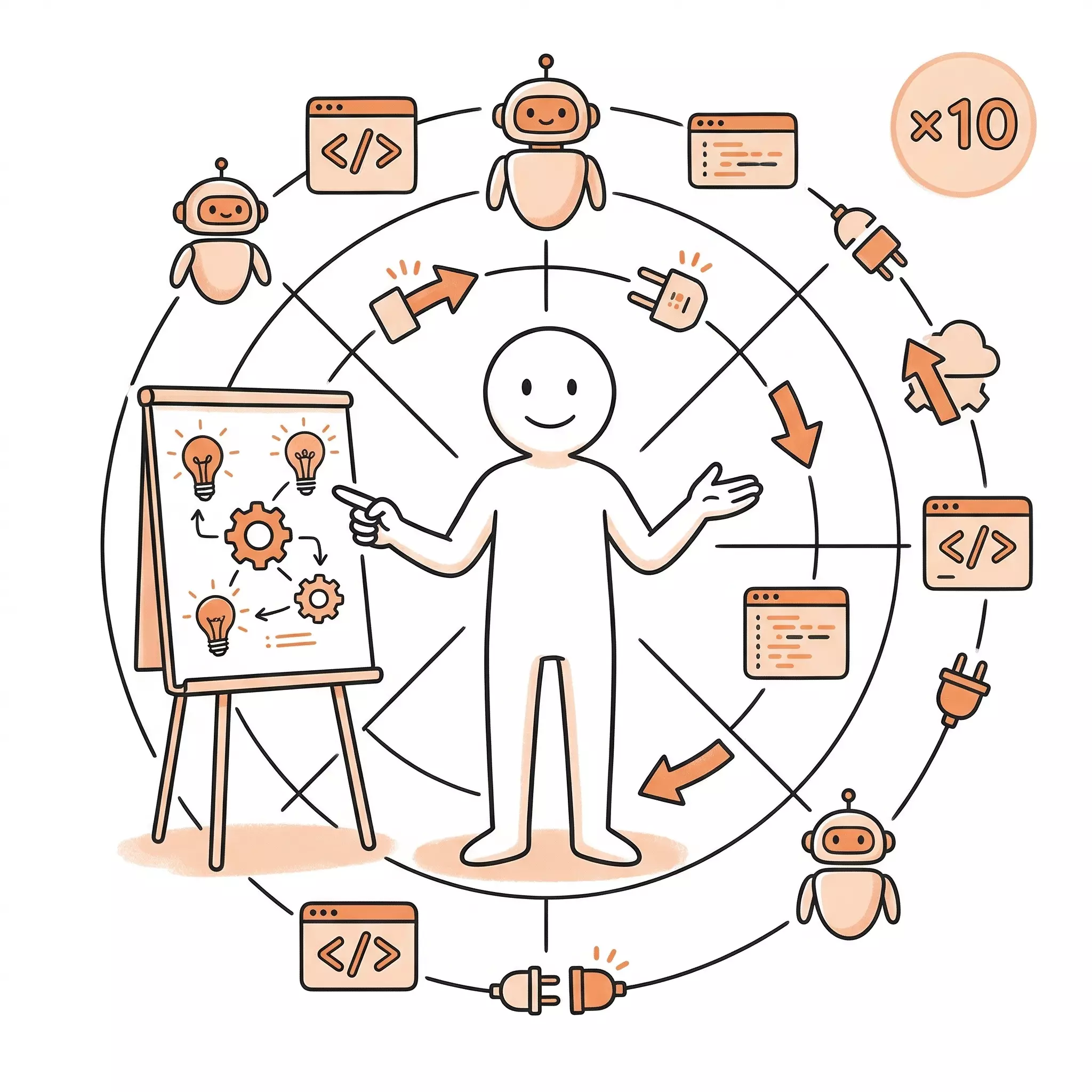
The AI Revolution Will Not Come from the Program Office.
Here's where most companies are going to get this wrong.
They're going to run AI transformation programs. Steering committees. Centers of excellence. Procurement processes for approved AI vendors. And those things will produce something — probably a policy document, a few approved tools, and a dashboard that shows AI adoption rates.
Meanwhile, the Mikes of the world — the operators who have always built things when the official path was too slow — will have already built something real. Quietly. With tools you didn't approve. Inside data boundaries you haven't mapped.
The AI revolution is already happening in your company. The question is whether you're going to find out about it before or after something breaks.
What Should Actually Happen.
Give select innovators access to real tools. Not a curated list of approved SaaS products — actual capability. Then have a small team of IT and Legal follow close behind: securing what gets built, formalizing what survives, changing process ownership when the evidence demands it.
Make it a token conversation, not a salary conversation. The cost to experiment is fractional now. The cost of missing the experiment is not.
Start building an internal microservice stack. If a vendor's tool is expensive, let someone build a leaner version in-house. The data stays internal. The capability stays owned. The process becomes serviceable by more than one person.
What this team actually looks like
A small group of proven operators with domain expertise, AI tool access, and explicit permission to experiment outside normal procurement timelines.
A lightweight legal and IT function that follows behind — not in front — securing what gets built, formalizing what proves out, flagging what creates real exposure.
A clear handoff protocol so that what Mike builds doesn't stay Mike's. The work gets documented, ownership gets assigned, and the process becomes institutional rather than personal.
Leadership decisions made explicitly about process ownership and delegation — not left to default to whoever was already doing it. In an AI-augmented environment, that conversation is now a cost-of-token versus cost-of-salary conversation. The math is different than it used to be.
And Deal With Mike's Excel File.
Not to replace it — to understand it, document it, and decide deliberately whether it should survive in its current form.
Because if it can't be touched, can't be serviced, and is sitting in the middle of your critical path — you've already lost the AI transition before it started. The question isn't whether AI can help your organization move faster. It's whether your organization has dealt with the load-bearing infrastructure that will stop any movement the moment someone pulls on it.
Mike's file is a symptom. The real question is what it says about how your organization handles the work that gets built outside the official process. Does it get formalized? Does it get resourced? Does it get handed off?
Or does it just become someone else's untouchable file in 2031?
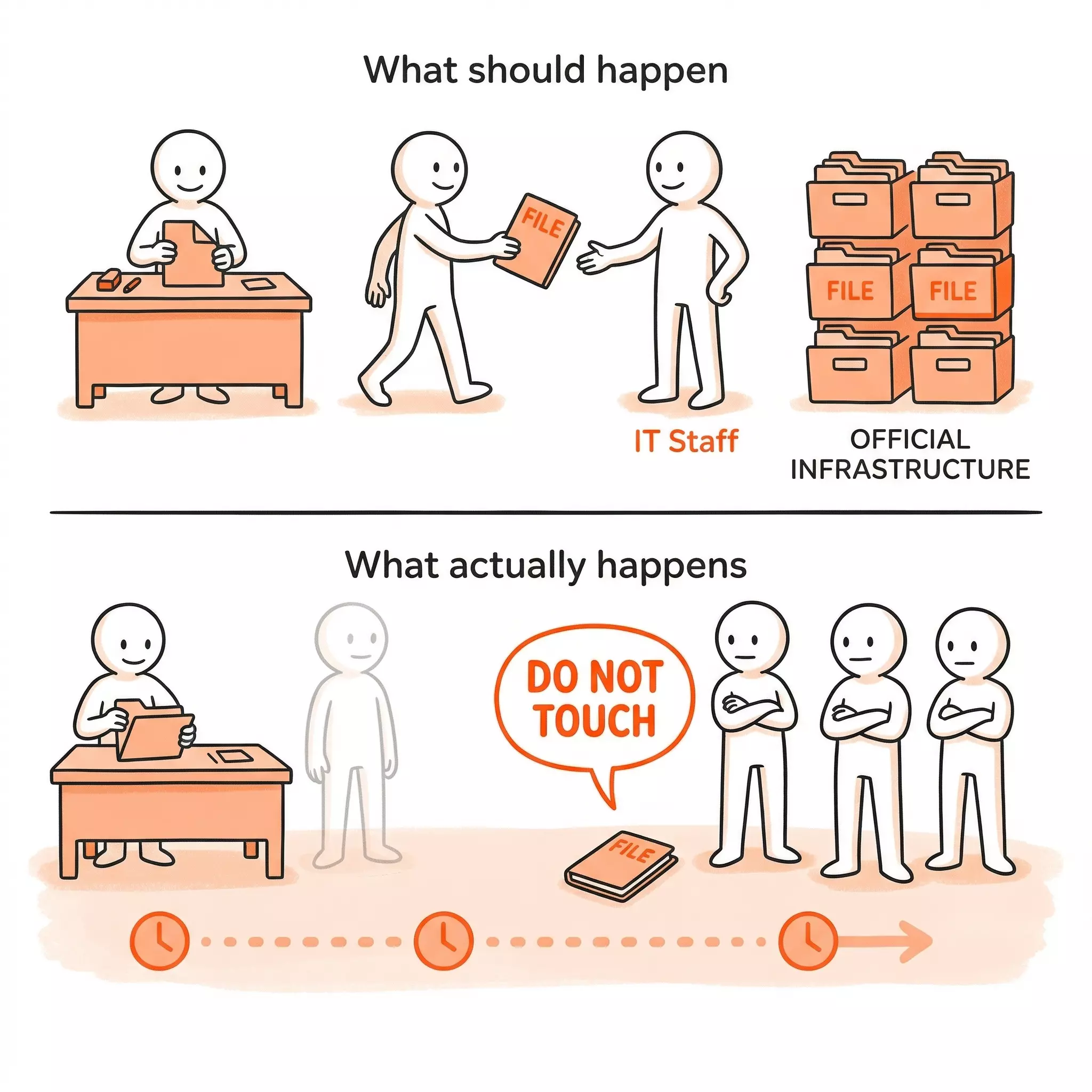
The Constraint Was Never the Technology.
It was always the same thing: teams that aren't structured to innovate, processes that can't be transferred, and leadership decisions about ownership that get made by default instead of intention.
AI is the most powerful change agent most organizations have ever been handed. And most organizations are going to use it to go faster inside the same broken structure.
The ones that don't will have decided — deliberately — to deal with the structure first.
That's not a technology decision. It's a leadership one.
What's the Excel file in your organization that nobody can touch?
Not literally Excel — the process, the system, the piece of load-bearing infrastructure that exists because someone built it when no one else would. I'd like to hear what it looks like.
Next: The person most likely to make sure Mike's file never gets formalized has been with the company for eleven years and was just promoted.