Is Your HR Team Running Your People Strategy — Or Just Taking Notes?
The function closest to the incentive design problem has almost never been given the mandate to solve it.
← Previous: The Process Owns the Requirement — the wrong question organizations ask before every AI deployment.
→ Next: coming soon.
The core argument
HR owns the performance systems, the compensation architecture, and the organizational structure — the three things that determine what behavior your environment actually selects for. In most organizations, HR is executing decisions made elsewhere rather than designing the incentive environment those decisions create. That's not a failure of HR as a function. It's a failure of organizational design. And it's one of the most expensive structural mistakes a growing company can make.
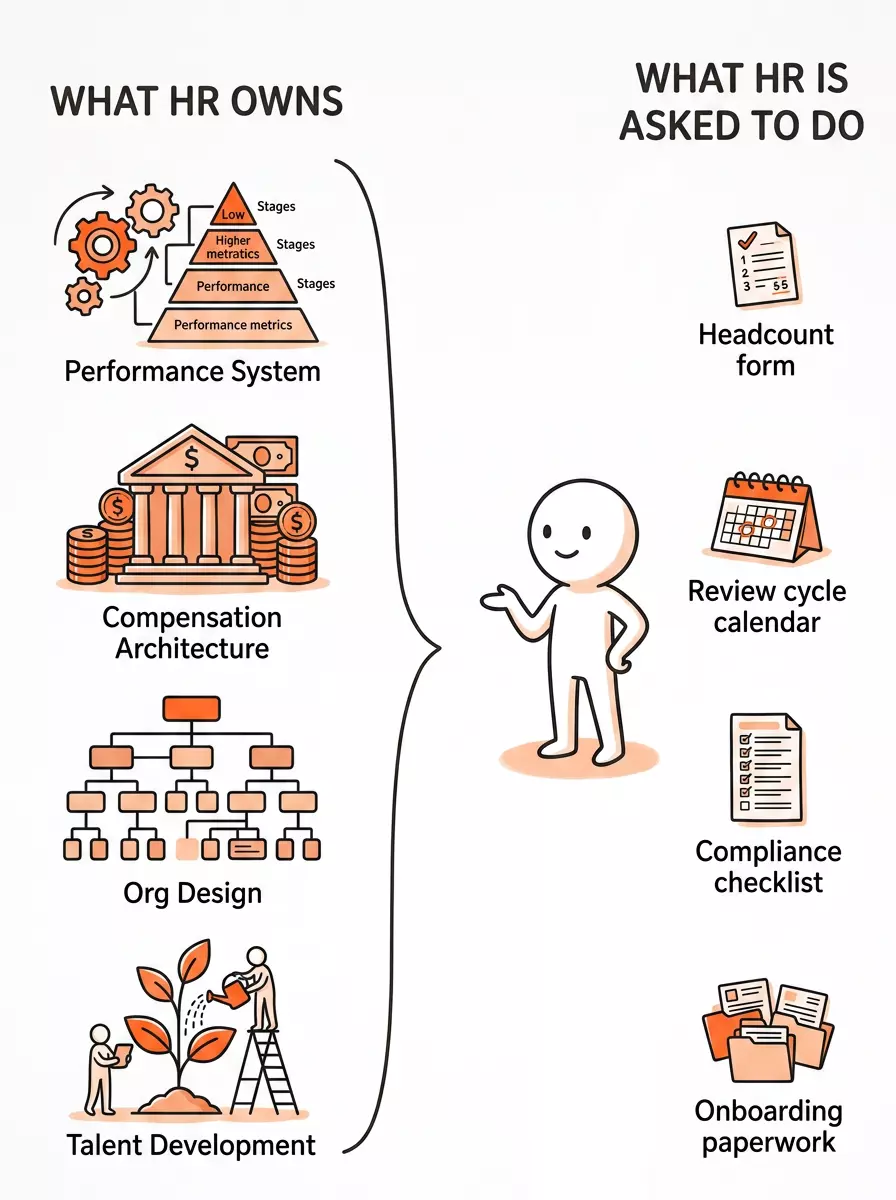
Think about what HR actually owns.
Performance management — the system that determines what behavior gets rewarded and what gets tolerated. Compensation design — the structure that determines what your people optimize for when their career is on the line. Organizational design — the architecture that determines who reports to whom, who controls what, and where the structural bottlenecks live. Talent development — the process that determines which capabilities your organization builds and which it lets atrophy.
Now think about what HR is typically asked to do.
Process the headcount request. Run the annual review cycle. Manage the compliance requirement. Administer the benefits package. Execute the onboarding checklist. These are important functions. None of them is environment design.
The gap between what HR owns and what HR is asked to do is one of the most significant structural mismatches in most organizations. And it's producing exactly the outcomes you'd expect from a system where the function closest to the incentive architecture has no mandate to design it.
What Happens When Nobody Designs the Environment.
Every piece of this series has been building toward the same structural conclusion: organizations don't fail because of bad people. They fail because of undesigned environments. Environments that were never deliberately built to make the right behavior the obvious one.
We've seen how this produces Coordinated Dysfunction — teams aligned to different incentive environments, each optimizing rationally for the signals their local system sends. We've seen how it produces the Last Checkpoint — a leader who didn't become obstructive by accident, but was manufactured by an environment that rewarded caution over outcomes over fifteen years.
The question this series has been building toward is: who is responsible for designing the environment so these things don't happen?
In most organizations, the honest answer is nobody.
Not because leaders don't care. Because the function best positioned to own that question was never given the mandate, the seat, or the data access to answer it.
HR Is Not Failing. It Is Being Used Wrong.
This is an important distinction — and it changes what the solution looks like.
The problem isn't that HR professionals lack the capability to operate as environment architects. Many of them understand the incentive alignment problem better than anyone else in the building. They see the patterns — which performance criteria are producing the wrong behaviors, where compensation structures are creating perverse incentives, which approval layers are generating the structural drag that stalls good ideas.
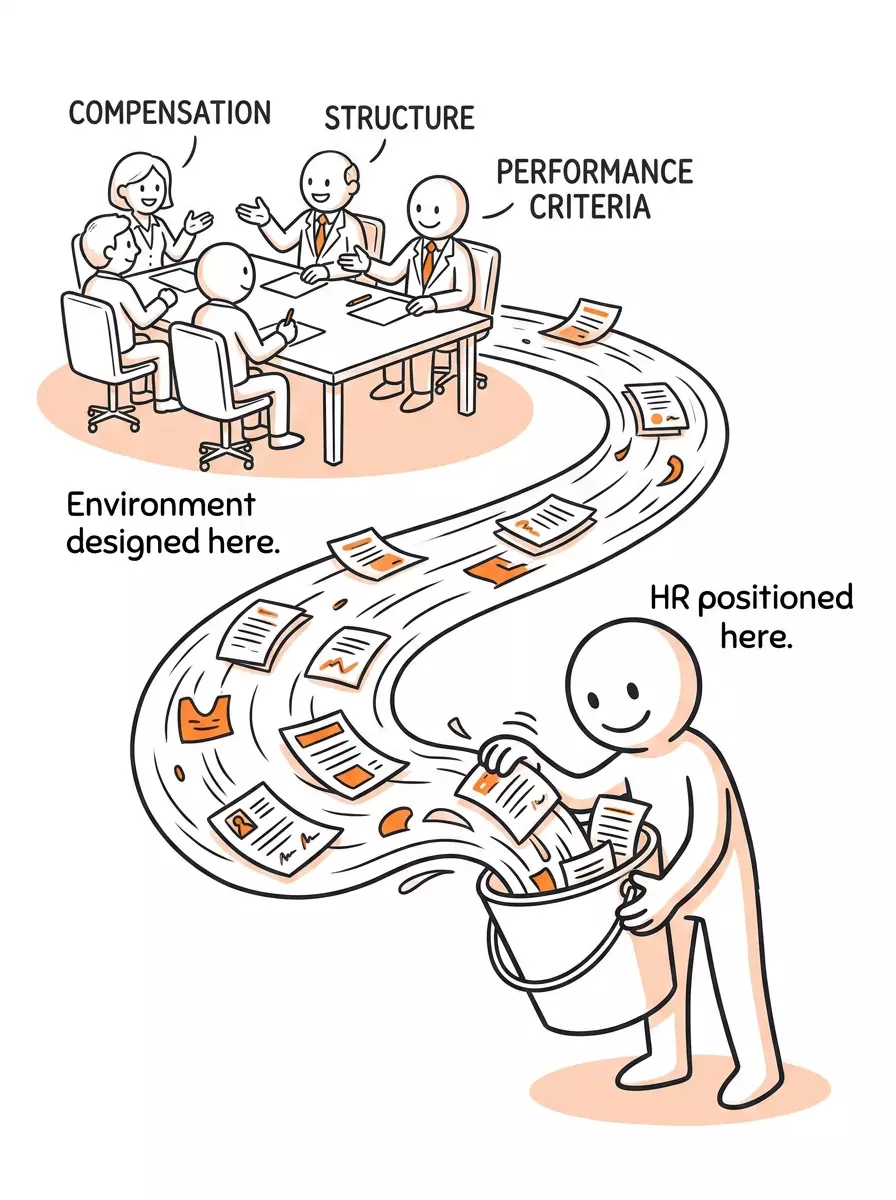
The problem is that they're executing decisions made in a room they weren't in.
The compensation structure was designed by Finance and approved by the CEO. HR administered it. The performance criteria were set by functional leaders in the annual planning cycle. HR ran the process. The organizational structure was decided in a reorg meeting with the executive team. HR processed the reporting changes.
At every critical moment of environment design — when the incentive signals were set, when the accountability structures were built, when the selection criteria for promotion were established — HR was downstream of the decision, not upstream of it.
HR isn't failing at environment design. It was never given the mandate to do it.
That's not a criticism of HR leaders. It's a criticism of how organizations have positioned the function — and of the leaders who positioned it that way without recognizing what they were giving up.
The Three Functions That Share the Problem.
HR isn't the only function implicated here. The environment design problem — the question of what behavior the organization's incentive architecture actually selects for — belongs to three functions simultaneously. And none of them fully owns it alone.
HR
Owns performance systems, compensation design, and org structure. Has the most visibility into what the environment is selecting for. Rarely has the mandate to change it.
Finance
Owns unit economics, capital allocation, and margin visibility. Determines what gets funded and what doesn't — which is an environment design decision whether Finance recognizes it as one or not.
Strategy
Sets the organizational direction that incentive structures are supposed to serve. Rarely has authority over compensation design or process architecture — the levers that actually determine whether people move in that direction.
Each function owns a piece of the environment design problem. None of them owns the whole thing. And the intersection — the place where performance systems, economic incentives, and strategic direction need to be designed as a coherent system — is where most organizations have a gap the size of their biggest structural problem.
Intentional Corporate Development
The function that looks at the whole organizational system — its costs, its pipelines, its processes, its people — and asks: are the incentives we have designed, at every level and across every division, creating win-win conditions that naturally align everyone toward where this organization needs to go? Most organizations have people who own pieces of that question. Nobody owns the whole thing.
What HR Operating As Environment Architect Actually Looks Like.
The difference between HR as administrator and HR as environment architect isn't a title change. It's a mandate change — and a seat change. The questions being asked, the data being accessed, and the decisions being influenced are fundamentally different.
HR as administrator asks: Are our performance reviews completed on time? Is our compensation benchmarked to market? Are our headcount requests processed? Is our compliance documentation current?
HR as environment architect asks: What is our performance management system actually selecting for — not what do we intend it to select for, but what does it produce, given how people respond to incentives when their career is on the line? Does our compensation architecture align the interests of our people with the outcomes the business needs at every level and across every division? When we look at who gets promoted, what does that tell us about what behavior the organization is actually rewarding? What does our org structure make easy, and what does it make hard — and are those the right things?
These aren't rhetorical questions. They're diagnostic questions. And they require data that HR typically has — performance patterns, compensation distributions, promotion history, attrition patterns — but rarely aggregates with the explicit intent of asking what the environment is selecting for.
The test for your own organization. In your last major decisions about performance criteria, compensation structure, or organizational design — was HR in the room as an architect or as an administrator? Did they influence the design, or did they receive the decision and execute it?
If the honest answer is the latter, you have a function with significant design capability operating as a processing layer. That's not an HR problem. That's a leadership decision — and it's producing an environment that continues to design itself.
Why This Matters More Right Now Than It Ever Has.
The case for HR operating at the environment design level has always been strong. In the current moment, it's becoming urgent.
The organizations navigating AI adoption successfully aren't the ones that found better tools. They're the ones that designed the environments capable of using those tools — environments where the incentive structures reward adoption, where the approval architectures don't obstruct it, where the people accountable for outcomes have the authority to redesign the processes that produce them.
That's environment design work. And the function best positioned to lead it is HR — if HR is operating as an architect rather than an administrator.
The organizations that get this right in the next two years won't just implement AI more successfully. They'll build something harder to replicate than any technology advantage: an organization where the right behavior is structurally obvious, where the incentives point in the same direction, where the environment reinforces the strategy instead of quietly undermining it.
That's the compound advantage. It doesn't come from the tools. It comes from the design.
And it starts with asking whether the function most responsible for that design has ever been given the mandate to do it.
Most organizations have never asked HR to be architects of the incentive environment. They've asked them to administer the outputs of decisions made elsewhere.
That's not a personnel failure. It's a structural one. And like every structural failure in this series — it produces exactly the outcomes it was designed to produce.
The question isn't whether HR is capable of operating at this level. The question is whether your organization has ever given them the mandate, the seat, and the data access to try.
What does your HR function actually own in your organization?
Not what the job description says. What decisions do they influence before they're made — versus which ones do they receive and execute? That gap is the size of your environment design problem.
The next piece in this series names the three functions that should collectively own the environment design question — and builds the case for the intersection that almost no organization has deliberately built. It's the function that doesn't exist yet. And it's the one that determines whether everything else in this series is possible.