
Most companies have a strategy document. Almost none have a strategy function. A document is a snapshot with no mechanism for staying current. A function performs three jobs continuously — translation, update, feedback — and without it, AI doesn't close your competitive gap. It accelerates whatever drift you already had.

Most companies have a strategy document.
It was produced in Q4 of last year, presented at the all-hands in January, and is currently living in a shared drive somewhere between the 2023 culture survey and the Q2 board deck. It has a vision statement. It has priorities. It may even have an honest section on where the company is falling short.
Almost none of them have a strategy function.
These are not the same thing. The gap between them is where execution goes to die.
What a Strategy Document Does.
A document captures strategic intent at a point in time. It is a snapshot — a record of what the leadership team believed about the market, the competition, and the company's capabilities on the day it was written.
It is useful for that. It creates alignment. It forces clarity. It gives people a common reference point.
But it has no mechanism for staying current. No mechanism for translating intent into operational decisions. No mechanism for detecting when execution has drifted from the direction the document pointed. It just sits there, periodically referenced in presentations and quarterly reviews, accumulating the weight of the decisions that were never connected to it.
What a Strategy Function Does.
A strategy function is an ongoing operational capability. It is not a department or a title — it is a system that continuously performs three jobs.
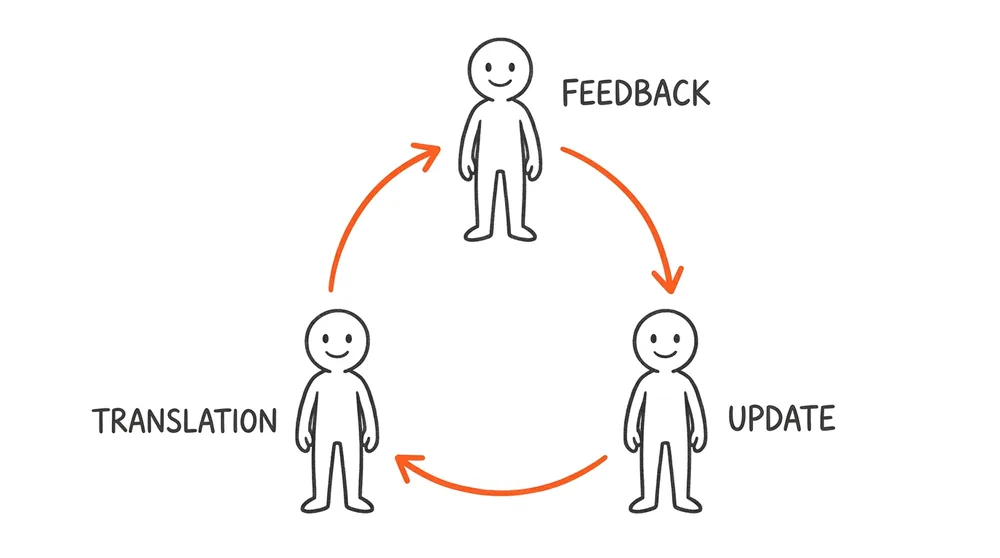
Translation. Converting strategic intent into the specific decisions that operational teams face daily. The strategy says "focus on the enterprise segment." The strategy function translates that into which accounts get priority in the pipeline review, which features get resourced in the next sprint, which partnerships get bandwidth and which don't. Translation is not a document. It is a recurring, active process.
Update. Incorporating what the market is doing into the operating model in real time. Competitors move. Customers shift. Regulations change. A strategy document updated annually cannot absorb any of this. A strategy function has a cadence — a mechanism for reading signals and adjusting the translation layer before the organization is six months behind.
Feedback. Connecting what is actually happening in operations back to strategic assumptions. When the enterprise segment turns out to be harder to crack than anticipated, the strategy function asks: is this a sales execution problem or a strategy problem? When a product decision produces an unexpected outcome, the strategy function asks: what does this tell us about the assumption it was based on?
Translation, update, feedback. Most companies have none of these as a designed function. They have a document and a hope.
Why This Matters More Now Than It Used To.
For most of organizational history, a slow-moving strategy function was survivable. Markets changed slowly. Competitors moved slowly. Execution drift was painful but recoverable.
That window is closing.
The gap between what a well-resourced, AI-capable competitor can do in six months and what an organization with a drifting strategy can do in the same period is now measurable. The organizations that are pulling ahead are not just executing better — they are operating inside a shorter feedback loop. Their strategy function is running at a cadence the document-based organizations cannot match.
And here is the part that matters: this is not a technology problem. The organizations that are losing ground are not losing it because they have worse tools. They are losing it because the layer that decides what the tools should be doing is absent or broken.
AI deployed into an organization without a strategy function doesn't close the gap. It accelerates whatever the organization was already doing — including the drift.
The Three Questions.
You don't need a consultant to diagnose whether you have a strategy function or a strategy document. Three questions will do it.

Who owns the translation of strategy into operational decisions? Not "who wrote the strategy document" — who is responsible for ensuring that the decisions made in the pipeline review, the resource allocation meeting, and the product roadmap session are actually consistent with the strategic priorities? If the answer is "the CEO" or "everyone" or a long pause, you have a document.
When did your strategy last change, and what triggered it? Not the annual planning cycle — an actual change in response to something that happened. If your strategy updates on a fixed calendar regardless of what the market is doing, you have a document.
What is the mechanism that connects operational outcomes back to strategic assumptions? When something unexpected happens in execution — a deal that fell apart for a reason nobody anticipated, a product that underperformed a well-reasoned forecast — how does that signal reach the layer responsible for strategic decisions? If the mechanism is "someone mentions it in the next QBR," you have a document.
What This Is Not Saying.
This is not an argument for adding a strategy layer between the CEO and the business. Layers are not the answer. Most organizations already have too many of them.
It is an argument for designing the translation, update, and feedback mechanisms that a strategy needs to function — to actually connect to the organization it is supposed to direct.
Those mechanisms can live inside existing roles. The CFO can own financial translation. The Head of Product can own roadmap translation. The Chief of Staff can own cross-functional coherence. The design question is not who to hire. It is whether the mechanisms exist at all.
Most of the time, they don't. The strategy document was written. The strategy function was assumed.
Does your strategy have a function or just a document?
The answer tells you more about your organization's ability to execute than the strategy itself.
— Raf Alencar