Nobody's Organized. And It Doesn't Matter Anymore
Everyone talks about architecture. Let's call it what it is: being organized. Nobody is. And for the first time in history, that might be okay.
← Previous: Coordinated Dysfunction — your teams aren't misaligned, they're optimizing for different things.
→ Next: The Process Owns the Requirement — coming soon.
I keep seeing the same word on my LinkedIn feed. Architecture. Good architecture. Sound architecture. Scalable architecture. Data architecture. AI architecture.
It's everywhere. And almost nobody outside the IT world knows what it means.
Here's what it actually means: being organized. That's it. Knowing where things are. Knowing how things connect. Having your information structured in a way that someone other than the person who created it can actually find it, use it, and build on it.
And here's the uncomfortable part: almost no one does this well. Not people. Not teams. Not companies. Not the ones with the biggest budgets, not the ones with the best reputations, not the ones who talk about it the most.
The core argument
Being organized has always been the real constraint — not talent, not tools, not strategy. We've been getting away with it for decades. That era is ending. But for the first time, the gap between what gets done and what gets documented is closeable — without requiring anyone to change who they are.
Let's Be Honest About This.
Think about your own life for a second. Your files. Your notes. Your photos. That folder on your desktop called "Misc" or "Temp" that's been there since 2019. The twenty tabs you have open right now because closing them feels like losing something.
Now multiply that by every person in an organization.
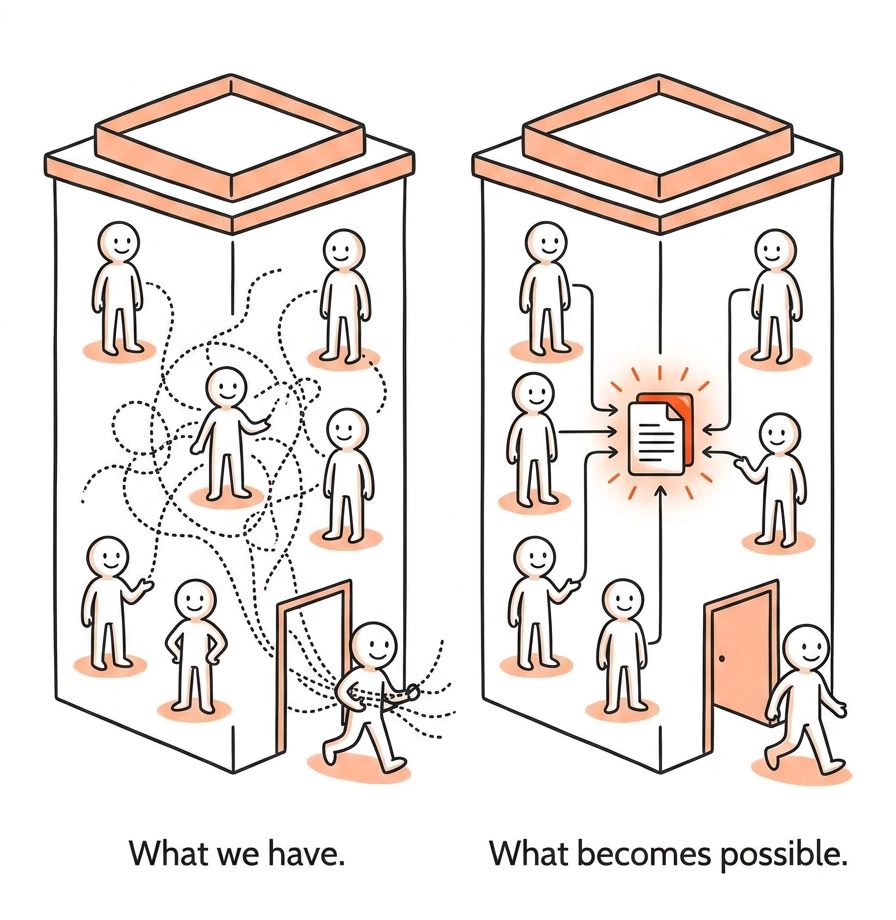
There's a famous line in business — often attributed to David Ogilvy, though the origin is debated — about why you'd never acquire a consulting firm: "Why would I buy a company whose assets go up and down the elevators every day?"
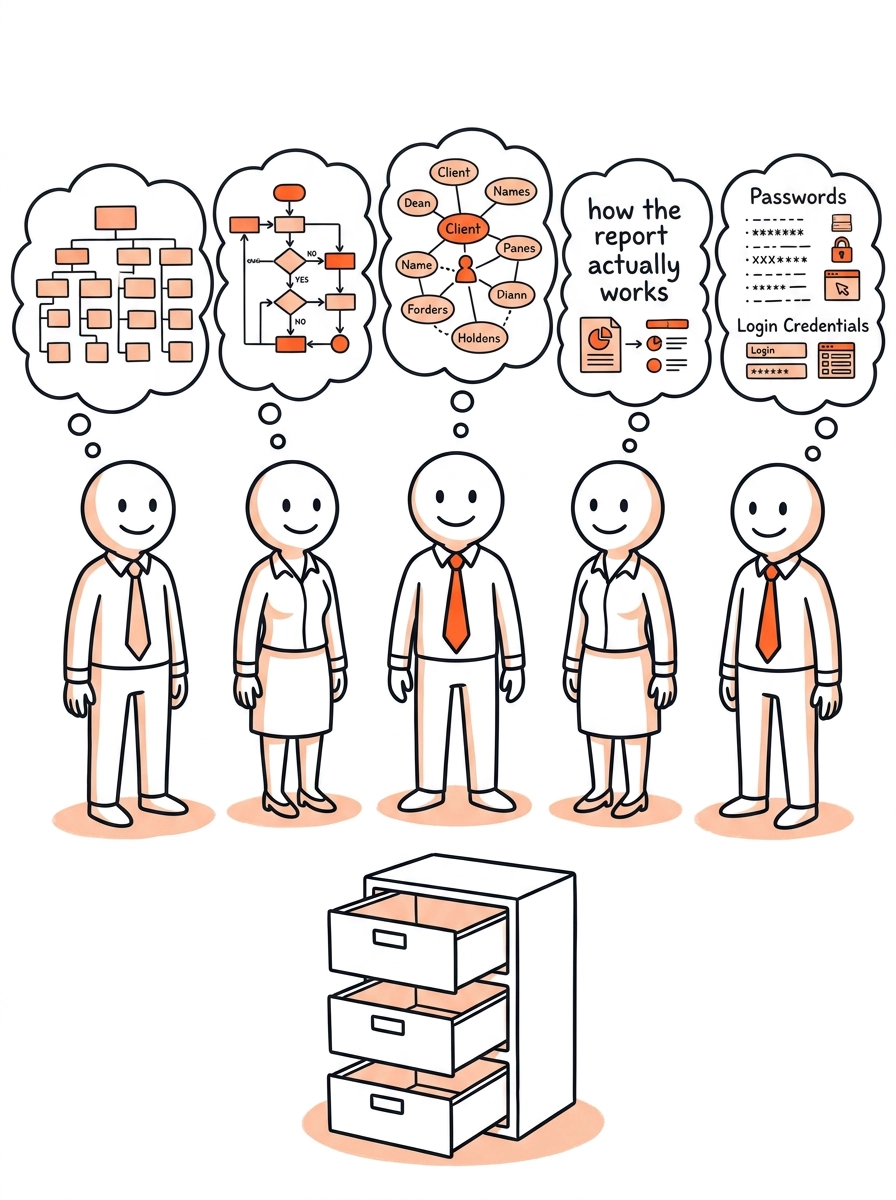
It's a line about people. But it's really a line about knowledge. The knowledge is in their heads. Not in the system. Not in a document. Not anywhere that survives their departure.
Every company knows this. Most have accepted it as a cost of doing business. We hire smart people, hope they stay, and scramble when they leave. The onboarding for their replacement takes months — not because the new person isn't capable, but because the knowledge wasn't organized. It was performed. Enacted daily in meetings, in relationships, in hallway conversations that shaped decisions that shaped outcomes that shaped the company.
None of it written down.
This Has Always Been the Problem. We Just Got Away With It.
Organizations have never been good at this. The pressure to deliver always outweighs the discipline to document. There's always something more urgent than updating the SOP. There's always a reason the process lives in someone's head instead of in a system.
And honestly? For a long time, it worked. Or at least, it was survivable.
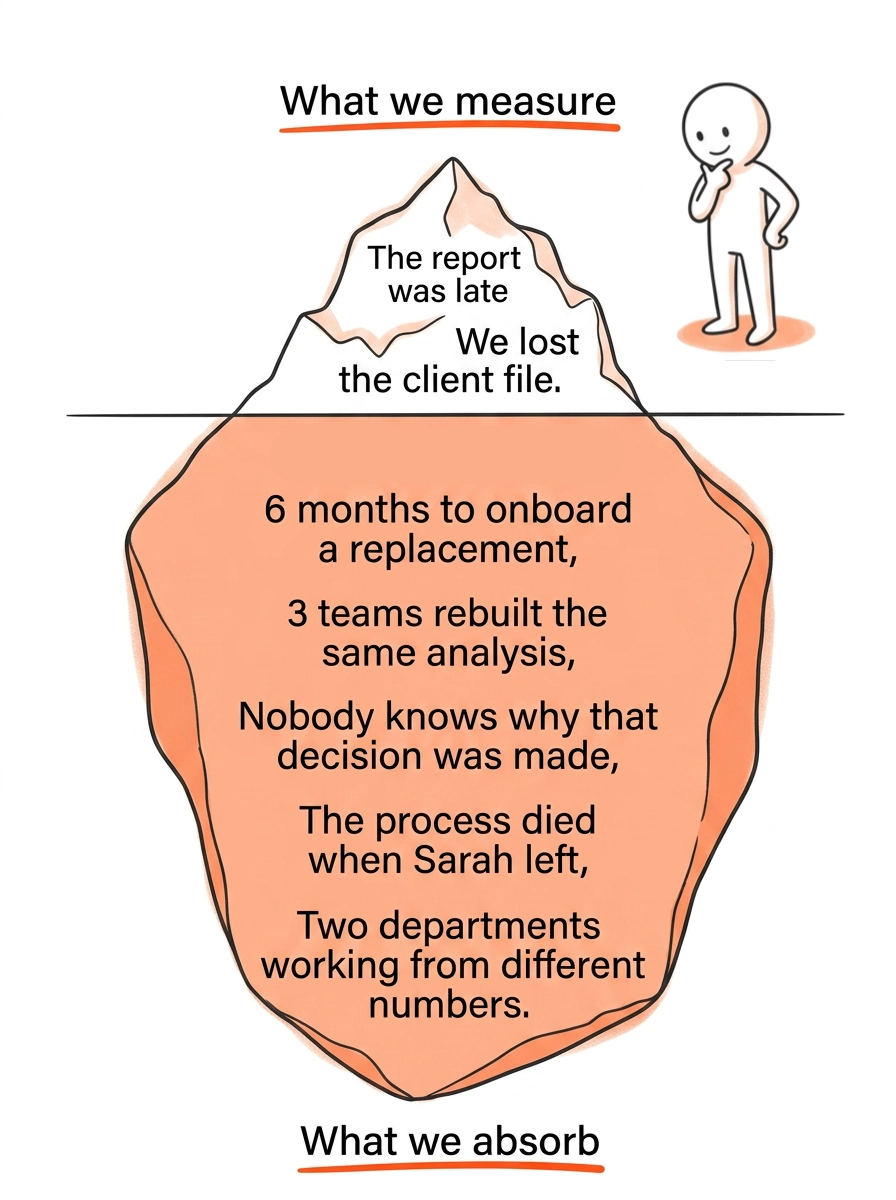
The cost of disorganization was diffuse. Slow. Hard to attribute. When a key employee left, the replacement took six months to get up to speed — but nobody tracked that cost explicitly. When a team couldn't find the report they needed, they rebuilt it — but nobody measured the duplication. When two departments discovered they'd been working from different versions of the same data, they sorted it out in a meeting — but nobody asked how that happened or how to prevent it.
The disorganization tax was real. It was just invisible enough to ignore.
Being disorganized wasn't a crisis. It was a steady, low-grade drag on everything — and the cost was never large enough at any single moment to justify stopping the machine to fix it.
So we developed workarounds. The person who "knows where everything is." The team lead who holds the context in their head and translates between departments. The employee who built a shadow system — a personal spreadsheet, a private Notion page, a set of bookmarks — because the official system didn't work for them.
These aren't failures of individual discipline. They're rational adaptations to an environment that never prioritized organization in the first place. And every single one of them made the knowledge more personal, more fragile, and more likely to disappear.
The Gap Just Became Visible.
Here's what changed.
For the first time, technology actually needs your organization to be in order. Not your people — your information. Your processes. Your knowledge base.
Every tool that promises to transform how you work — every AI assistant, every automation platform, every agent that's supposed to save your team forty hours a week — runs on the same fuel: organized, accessible, structured knowledge. Context. Information that's findable, current, and connected to the decisions it supports.
And most companies don't have that. Not because they didn't try. Because they never had to.
This is the quiet reason most AI initiatives stall. Not because the technology doesn't work. Not because the models aren't good enough. Because the knowledge they need to work with was never organized in the first place. The AI is fine. The environment it's operating in is the constraint.
Companies are discovering this in real time. They buy the tool. They plug it in. They point it at their data. And the results are mediocre — not because the AI failed, but because the knowledge base it's drawing from is fragmented, outdated, duplicated, contradictory, or locked inside someone's head where no system can reach it.
The disorganization that was invisible for decades just became the most expensive problem in the building.
Here's Why It Doesn't Matter Anymore.
If the story ended there, this would be a depressing article. "You're disorganized, and now it's going to cost you." Thanks. Very helpful.
But the story doesn't end there. Because the same technology that exposed the gap is also the first technology in history that can close it — without requiring the humans to change.
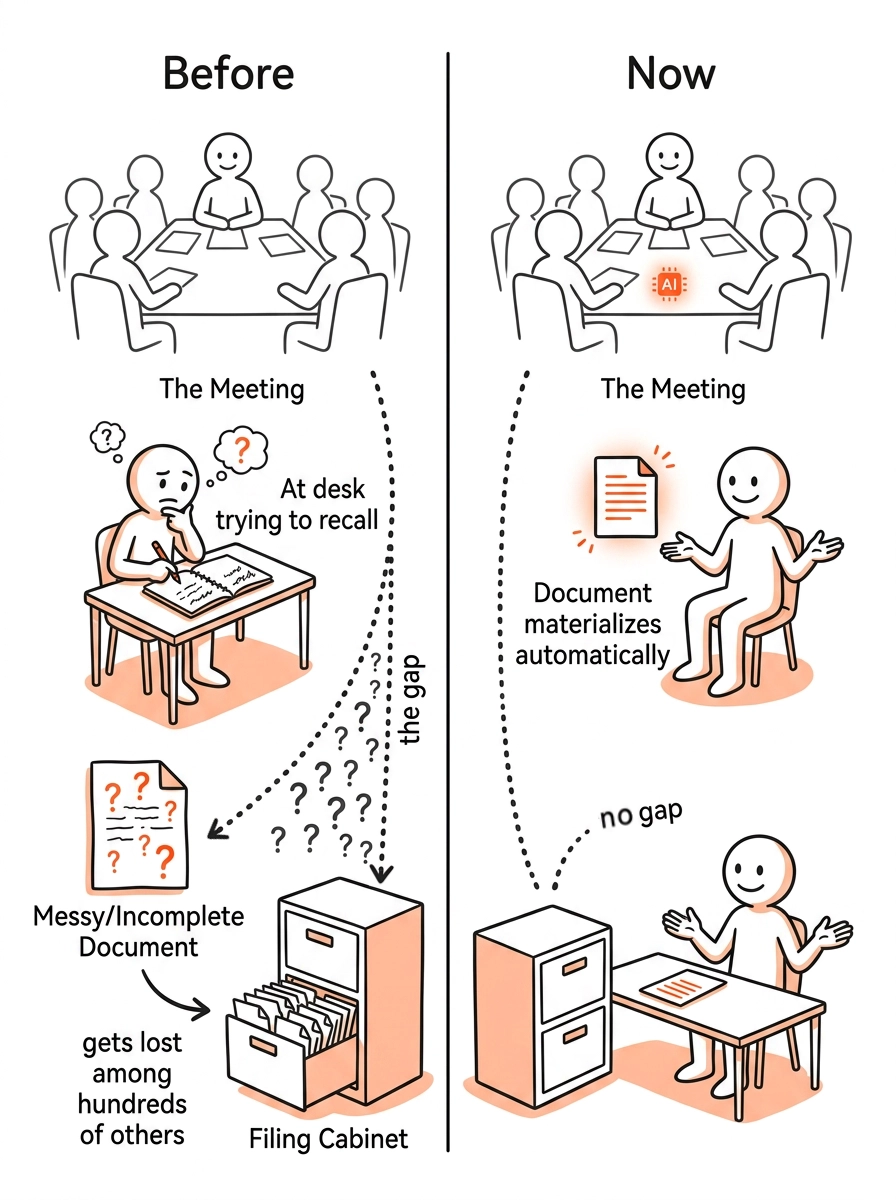
Think about what's already happening. Meeting transcription tools that capture every conversation automatically. AI assistants that summarize discussions, extract action items, draft follow-up documents. Systems that turn a conversation into a structured record without anyone stopping to take notes.
Most people look at these tools and see "time savings." A meeting that used to require manual notes now creates its own summary. Good. Thirty minutes saved.
But that's the surface. What's actually happening is more fundamental.
For the first time, the gap between something happening and that thing being documented is collapsing. Not because people got more disciplined. Because the documentation became a byproduct of the work itself.
The person who's not great at organizing? Doesn't matter. The meeting happened. It got captured. The knowledge exists outside their head now — searchable, retrievable, connected to everything else.
The team that never updates their SOPs? Doesn't matter — at least not in the same way. The processes are being observed, recorded, and structured as they happen. Not perfectly. Not yet. But the trajectory is clear: the act of doing the work is becoming the act of documenting the work.
That's not a productivity gain. That's a paradigm shift.
The Person Gets Better. Not Because They Changed.
There's a human side to this that doesn't get talked about enough.
When the documentation layer runs on its own — when the knowledge capture happens automatically — the human gets to stop compensating. They get to stop splitting their attention between participating in the conversation and recording the conversation. They get to stop worrying about whether their boss will find their work, because the work is findable by design. They get to be fully present in a meeting instead of half-present and half-documenting.
That's not a small thing. Anyone who's ever sat in a meeting trying to simultaneously contribute and take notes knows the cognitive cost. You're never fully doing either. The documentation overhead doesn't just consume time — it degrades the quality of the actual work.
Remove that overhead and something shifts. The person who was "disorganized" — the one who always had brilliant ideas but terrible follow-through on documentation — suddenly has a complete trail of everything they've done. Not because they became more organized. Because the environment organized itself around them.
And the person who was already organized? They get their time back. The hours they spent building personal systems, maintaining private trackers, creating the structure that the organization should have provided — those hours return to the work that actually matters.
This is the reframe that matters. The conversation about AI and work keeps centering on replacement. Who gets replaced. Which jobs disappear. That's the wrong frame for what's happening here. The right frame is: the activity that almost nobody does well and almost every organization needs — capturing, structuring, and making knowledge accessible — just became something the environment can do on its own.
Not replacing the human. Bridging the gap the human was never going to close.
The Organizational Unlock Nobody's Talking About.
Now scale this from the individual to the company.
If every meeting is captured. If every decision has a trail. If every piece of work produces a document — not a status flag, not a Slack message, not a thumbs-up emoji on a thread that'll be buried by tomorrow — but an actual, findable artifact that records what was done, what was decided, and why.
What happens?
Something that's never existed before: the organization's actual operating system, made visible.
Not the org chart. Not the process documentation that was written three years ago and never updated. The real thing. The living, breathing way the company actually makes decisions, allocates resources, resolves conflicts, serves clients, and develops its people. The patterns. The decision paths. The institutional knowledge that currently lives in the space between humans — in relationships, in shared context, in the things people just "know" because they've been there long enough.
Right now, all of that is invisible. Emergent. Unwritten. When people leave, it degrades. When teams change, it fractures. When a company grows fast, it dilutes. And when someone asks "how did we end up making that decision?" the answer is usually a shrug and a reference to a meeting that nobody documented.
The organization's real operating system has never been written down. It's been performed — enacted daily by the people inside it. And it disappears the moment they stop performing it.
Now imagine that performance is being captured. Continuously. Not by a surveillance system watching employees — by a documentation layer that makes the knowledge persistent. The conversations that shaped a strategy. The data that informed a pivot. The reasoning behind a budget allocation. The pattern of how client escalations actually get resolved versus how the manual says they should.
That's not just better documentation. That's the organization becoming legible to itself for the first time.
And once it's legible, something else becomes possible. You can see where decisions went wrong — not to blame, but to learn. You can see which processes actually work versus which ones exist on paper and get routed around in practice. You can onboard a new hire in weeks instead of months, because the institutional knowledge isn't locked in someone's head anymore — it's in the system, searchable, structured, and connected.
And yes — when someone leaves, the knowledge stays. Not all of it. Not the judgment, not the relationships, not the intuition that comes from years of experience. Those remain human. But the decisions they made, the reasoning they used, the patterns they established, the context they carried — all of that persists. The assets don't go up and down the elevators anymore. At least, not all of them.
The Two Problems Nobody Has Solved Yet.
Before this starts sounding like a technology sales pitch, let me name the hard parts. Because they're real, and pretending they're solved doesn't help anyone.
The first problem is retrieval. Capturing knowledge is only half the equation. The other half — the harder half — is finding it again. And anyone who's worked in a company with a shared drive knows exactly what I mean.
Marketing creates a folder structure that makes sense to Marketing. Finance creates a different one. HR creates a third. Now the financial report that Marketing needs lives in Finance's structure, organized by Finance's logic, findable only if you think the way Finance thinks. So Marketing creates their own copy. Now there are two versions. Neither is current. And the person who "knows where the real one is" just went on parental leave.
This isn't a technology problem. It's a design problem. The way we organize files was built for how individual humans think — in hierarchies, in categories, in folders that mirror their mental model. But organizations don't have one mental model. They have dozens. And a system designed around one person's logic becomes a maze for everyone else.
Capturing everything is meaningless if finding anything requires knowing exactly where someone else put it.
The second problem is structure. Even if you solve retrieval, there's a deeper question: how do you ensure that the knowledge base isn't just a pile of documents, but a connected system where decisions link to evidence, processes link to outcomes, and changes are traceable over time?
A flat dump of meeting transcripts and AI summaries is better than nothing. But it's not institutional memory. It's a landfill with a search bar. The real value isn't in having the documents — it's in the relationships between them. Which meeting led to which decision. Which data informed which strategy. Which client conversation changed which product direction.
That structure doesn't emerge on its own. Someone — or something — has to design it.
Where this leaves us
The technology to capture knowledge automatically is here. It works. It's getting better fast. The gap between "it happened" and "it's documented" is closing.
The technology to retrieve and structure that knowledge in ways that actually make organizations smarter? That's the frontier. That's the design challenge that will separate the companies that merely adopt AI from the ones that fundamentally transform how they operate.
The capture problem is being solved. The retrieval and structure problems are where the real work — and the real opportunity — lives.
Being Organized Was Never About Discipline. It Was About Design.
Here's what I've learned from twenty years of watching organizations try to get their act together.
The companies that are well-organized didn't get there because they hired more disciplined people. They got there because they designed environments where being organized was the path of least resistance. Where documentation was a byproduct, not an additional task. Where finding information didn't require knowing the right person to ask or the right folder to look in.
And the companies that are perpetually disorganized? They're not full of lazy people. They're full of smart people operating inside environments that never made organization easy — and then wondering why nobody does it.
That's the lens that changes everything. Stop asking "why aren't our people more organized?" Start asking "what would our environment need to look like for organization to happen automatically?"
Because for the first time, that question has a real answer. Not a theoretical one. Not a framework on a slide deck. A real, buildable, deployable answer.
The gap between what organizations know and what organizations have captured has been the most expensive invisible problem in business for decades. Entire consulting practices exist because companies can't access their own knowledge. Entire roles exist because someone has to be the human bridge between what the company knows and what the company can find.
That gap is about to close. And the organizations that close it first won't just be more efficient. They'll be something entirely new — companies that can actually see how they work, learn from how they've worked, and design how they want to work next.
Nobody's organized. It's true. It's always been true. But for the first time, it doesn't have to stay that way — and it doesn't require turning every employee into a meticulous note-taker to fix it.
It requires designing the environment so that the organization happens whether anyone is paying attention to it or not.
That's not architecture. That's not a technology initiative. That's the most important design decision your company will make in the next five years.
And almost nobody is making it yet.
Ask yourself one question.
If your three most knowledgeable people walked out tomorrow — not the most senior, the most knowledgeable — how much of what they carry in their heads exists somewhere the rest of the company can access?
That's the gap. And for the first time, it's closeable.
The next piece in this series is about the design error that sits upstream of every failed AI implementation — and why the first question most organizations ask before deploying a new tool is the wrong question entirely.