
On a panel last weekend, I told an accounting student how to pitch automation skills to an employer: "don't say the AI part."
Say you can build code that automates the repetitive work. Leave the label off, because some companies are touchy about it.
Fin Dittimi, who builds AI guardrails and compliance structures for a living, described the other side of that touchiness on the same panel. People have started to read AI-assisted work as lazy work.
So the label does nothing for the student, and it counts against some of the work it gets attached to. Companies are still putting it on the first slide of the strategy deck.
"AI-first" describes what a company says it is. Nobody can check it, so nobody is held to it.
The plan underneath it usually sounds like this: "I'm just going to give AI to all my employees, and all of a sudden my company is going to be more efficient. That's just not right either."
It's not right because your competitors are doing exactly the same thing.
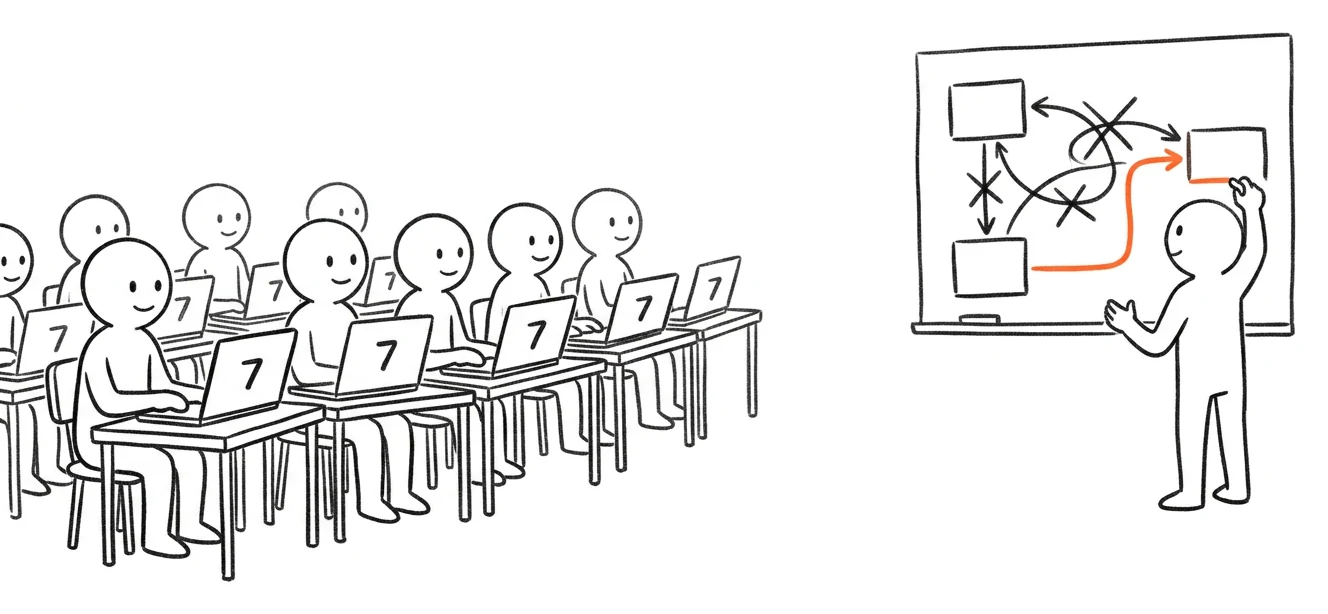
Everyone Gets the Same 7
Ask a model to pick a number between 0 and 10 and it says 7 far more often than chance would predict. These systems are built on statistics, and the most likely answer is the one you get.
Business questions work the same way. Ask for a marketing plan with no other context and the answer will be very similar across most of the AI models. Switching vendors doesn't change that.
Now apply it to your own market. Your competitors hold the same licenses, and their people are typing the same questions about the same customers. If that is what AI-first means, all of you get the 7.
Speed doesn't fix it either. If the answer is generic or wrong, going faster means, in Fin's words, "scaling a bunch of wrong information really fast."
What moves the answer is what the model can't get from anyone else: how your business actually runs. Your cost structure, your customers' exceptions, the reason one step comes before another.
Typing that into a prompt gives one person one better answer. The business only benefits when the work has been rearranged so that the context is written down and the model sits inside the process, carrying part of it. A license doesn't do that for you. Somebody has to design it.
Which is the claim I'd make in place of the label: be first to AI, inside your own competitive set.
"First" doesn't mean the earliest pilot or the first enterprise license. It means being first, among the companies you actually compete with, to redesign something load-bearing in how you deliver value.
The test is external. You've done it when a competitor can't match your output or your economics without doing the same redesign themselves. If they can catch up by buying what you bought, you were early, and that's all.
"First" is a threshold, not a timestamp.
That is why this doesn't turn into a speed race. I've argued before that the few companies getting real returns from AI weren't the ones with the most of it. They were the ones that redesigned the organization. This is the same argument, seen from the competitor's side.
The Mandate Sets the Ceiling
How far a redesign can go depends on who was asked to do it.
An analyst automating their own work is limited to what they can see. A department head is limited to the department. IT, running AI as a rollout, centers on cost and security. That's its job, and it isn't the business.
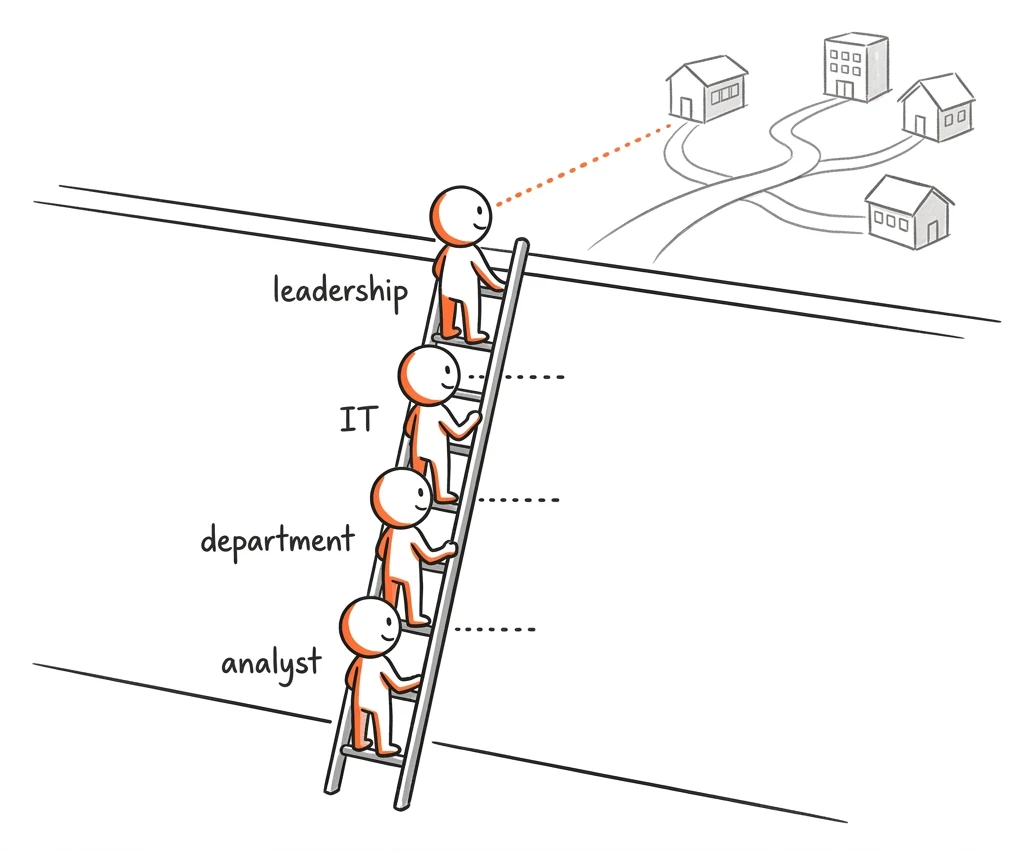
Many large enterprises haven't reached even that rung. On AI governance, Fin said, a lot of them "do not even have a team in place that is able to build a template for this and propagate around the organization."
The gains worth having sit between those mandates. Take the repetitive work spread across accounts payable, accounts receivable and the controller. Each team can speed up its own piece. None of them was asked why the work is divided that way, and the answer sits in somebody else's territory.
This is also where the competitive test gets decided. Whatever one team can automate alone, your competitor's team can automate alone with the same tool. A redesign that crosses three teams is hard to copy, because copying it takes the same mandate.
Challenging a process used to be expensive. You needed the specialist, the specialist's time and a project. Now you can build the test case yourself and see whether the idea holds.
The authority to ask didn't get cheaper. Wherever nobody holds it, "that's not how it's done" still wins, whatever the test showed.
So the mandate has to be as wide as the process. An analyst's mandate gets you a faster analyst.
The reason to settle this now is that somebody else has already started. The most dangerous competitor you have isn't another company. It's a leaner version of your own business model that someone is already building.
Juan Cabrera, who builds these tools with companies, said on the panel that people who understand a subject completely but could never build software can now have an MVP "in pretty much a few hours." They don't need an engineering team. Some of them know your industry as well as you do.
They start with no legacy process and nobody in the room to tell them that's not how it's done. You can't limit their use of these tools. You can only out-design them, and you hold the one thing they don't: a running business and everything it knows.
One distinction, because the word invites confusion. This is not the race to be first to AGI, where the prize goes to whoever arrives first, guardrails or not. That race pays for arriving early. This one pays for a redesign that holds weight.
So here's the question I'd take into Monday's leadership meeting: who in your company has the mandate to ask why a process that crosses three teams works the way it does?