
I just participated in a panel discussion this weekend about Agency in the Age of AI, and it was one of the more honest conversations on the subject I've been part of. Nobody was selling the hype and nobody was selling the fear. Everyone on it does this work for a living, and it showed.
AgileEx framed it as how AI can expand our ability to act, create and lead without taking away our control. Put more simply: does AI give people more control over their work, or less?

Who was on the panel
Fin Dittimi, founder and principal consultant at FandF Consultancy, got into AI before it was fashionable: biometrics first, then a doctorate in machine learning and pattern recognition at Concordia. Today he ships products and builds the guardrails and compliance structures companies need to run AI without losing track of it.
Juan Cabrera, head of digital transformation and AI at JEGantic, came to Canada as a kid, decided the standard path wasn't for him, and built his own business in tech. He helps companies build the tools that put AI to work for their teams.
Mahsa Rezaei, founder and executive director of Intelligent Nest Institute, has been doing AI transformation for fourteen years, as she put it, "without AI." She started in business process re-engineering, built Intelligent Nest to help nonprofits redesign their work, and runs a second social enterprise focused on protecting women's agency in the future of work. Her younger daughter's first word was "AI," because she rehearsed a talk in front of her one too many times.
A researcher turned builder, a self-made founder, and a work-redesign specialist. Three different directions into the same question, and they kept landing in the same place.
The moments that stuck with me
Our host, Nicolangelo (Nick) Piccirilli, founder of AgileEx, opened with a picture of a tiger hiding in plain sight. Sometimes you spot it, sometimes you don't. The tiger hasn't changed, Nick said; only our perception has. Most of the public AI debate is about perception. The panel spent the next hour on the parts that aren't.
Mahsa gave the line I'll be repeating for a while: agency doesn't survive on good intentions. It has to be designed into the work, the roles and every decision. If nobody designs it, it gets designed away by default. She backed it with practice. Before AI enters a process, she maps who holds the decision rights and puts a name next to every output. Her test: if you can't explain a decision without saying "because AI said so," you didn't make that decision.
She also drew a distinction that sounds small and isn't. Asking AI "what should I do?" is the fastest way to hand over your autonomy. Asking "what am I missing, and what's the strongest argument against me?" keeps it.

Fin reframed what's scarce. Analysis used to be the expensive part; now a first draft of almost anything is cheap. What became scarce is framing a good question and judging what comes back, including spotting when AI is confidently wrong. His image for speed without judgment was the sharpest of the day: double your speed from Montreal to Toronto in the wrong direction and you don't arrive sooner, you just get further away faster. On leadership, he said leaders can't just be the human in the loop. They have to build the structure the loop runs in, down to access controls for agents, not only for people. AI doesn't replace judgment, he said. It makes judgment the most valuable thing we have.

Juan brought it back to what these models are: statistical predictions of what comes next. Ask one what two plus two equals enough times, he said, and eventually it'll say five. So you have to know the subject well enough to catch it. He also reframed guardrails for me: even autonomous agents have them, and every guardrail is a human decision. When an agent goes over one, someone set it too low. Asked what AI gives us and what it takes away, he had the same answer for both: our decisions.
My own contribution started with delegation. Executives have always handed work to copywriters, editors and analysts. What's new is that delegation got cheap enough for everyone. So my question for anyone worried about losing control is this: if you had a team working for you, would you be doing anything differently? If you would, that's what will happen with AI.
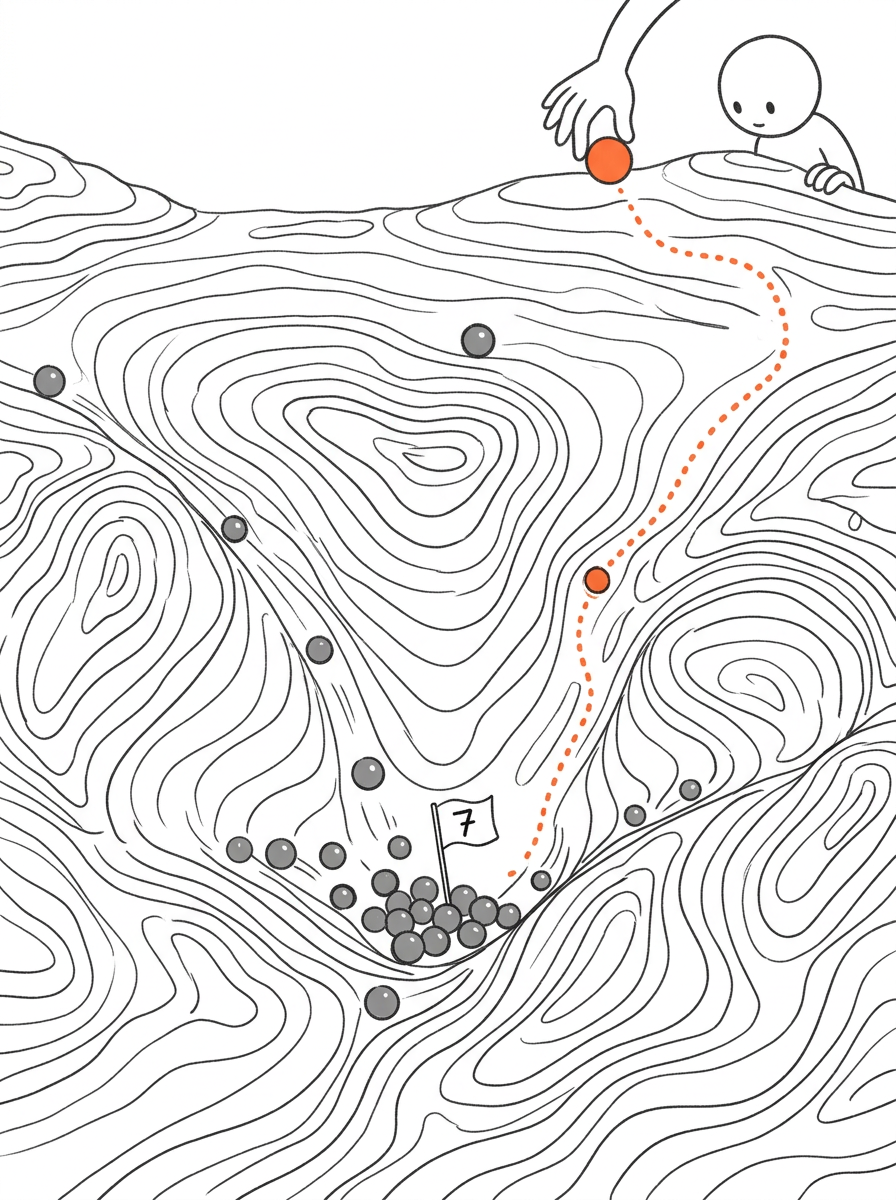
On creativity, I argued that in most organizations creativity was always filtered by whoever sat at the top, and that AI is built on averages. Ask it to pick a number between 0 and 10 and it says 7 far more often than chance. Your question is a marble dropped on a landscape. It rolls downhill to the same spot everyone else's does, unless you change where you drop it.
The question that mattered most
The best question came from the audience. An accounting student asked how you build judgment when the entry-level tasks that used to build it are the first ones AI takes.
Fin answered with learning to drive. Once you've driven, you can tell from the passenger seat whether the driver knows what they're doing. AI won't remove entry-level roles, he said. It removes the repetitive part, and someone still has to know enough to supervise it. Most large organizations haven't even built their AI governance yet.
My answer was more practical. You'll be handed an SOP: copy this here, extract those reports, paste that there. Learn it. Then ask, step by step, whether each one could be easier, and use AI to answer that one step at a time. Do that for a few months and you won't just know the tasks. You'll know the process, and that's the expertise most companies are missing. Even the people on that panel are still advising companies that don't yet know how they'll use AI.
What I took away
Four people, four different paths into this work, and the same conclusion from every direction.
AI doesn't decide how much agency you keep. The way the work is designed does.
Mahsa calls it decision rights. Fin calls it judgment and structure. Juan calls it guardrails. I call it the environment. The word changes; the work doesn't.
Thank you to Nick and the AgileEx team for hosting, to Fin, Juan and Mahsa for the conversation, and to everyone who joined us.
So here's my question for you: in the work you do every week, which decisions have a name next to them, and which ones are already being made by default?