
Who should own AI? Most companies hand it to IT or a new committee and treat it as a technology question. It's an environment question, and three functions should own your environment: the CEO, HR and strategy. In most companies none of them does, and the dysfunction lives in that gap.
I started making this argument on a panel in November. The question was about creativity, and I said I'd answer it as a question about creativity and leadership.
Creativity has always been filtered by whoever sits at the top. Tell your team exactly what you want for a pitch and one version comes back. Tell them to explore and five come back.
The call dropped before I got to the leadership half. This is the rest of that answer.
By environment I mean what the company actually selects for: who gets hired, what gets paid, who gets promoted, and what happens to the person who disagrees in the meeting. Every company has one. Very few can tell you who designed it.
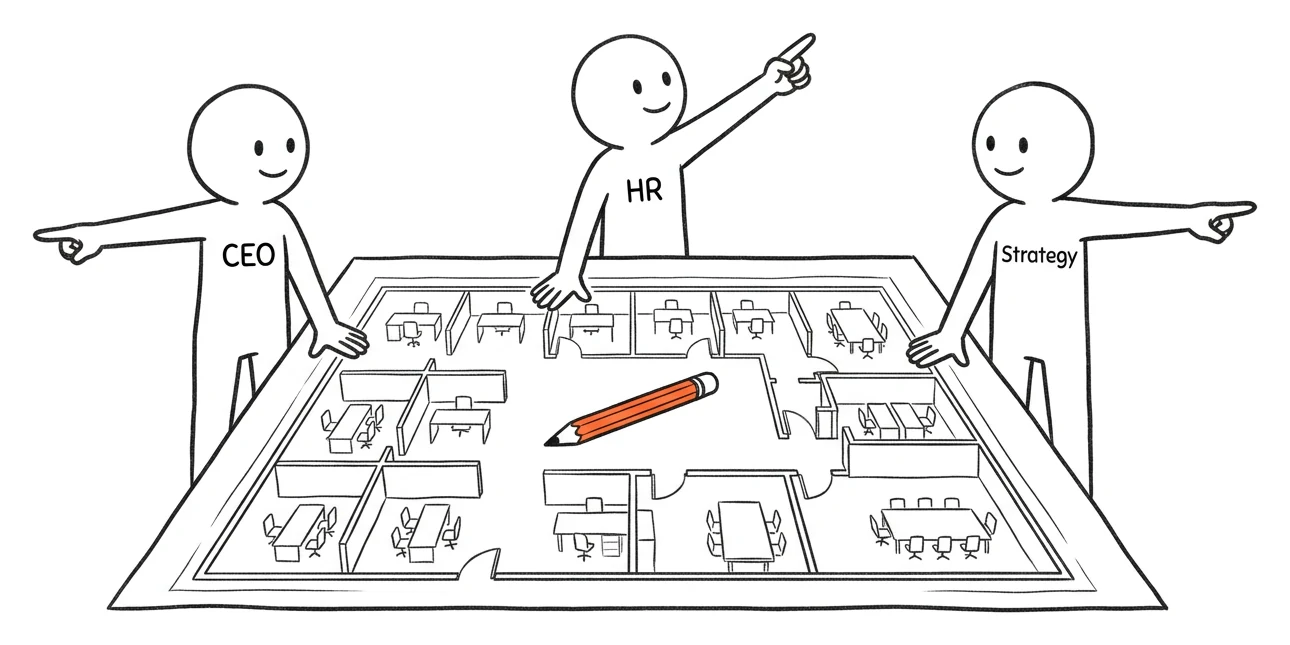
You Get the Environment You Hire For
Start with the CEO, because the other two work inside whatever the CEO allows.
A CEO who wants an HR director who won't challenge them will get one. A CEO who wants a yes-man in operations will get that too. Nobody writes it into the job posting. It shows in who gets the offer and who lasts, and everyone else in the company reads those hires as the rule.
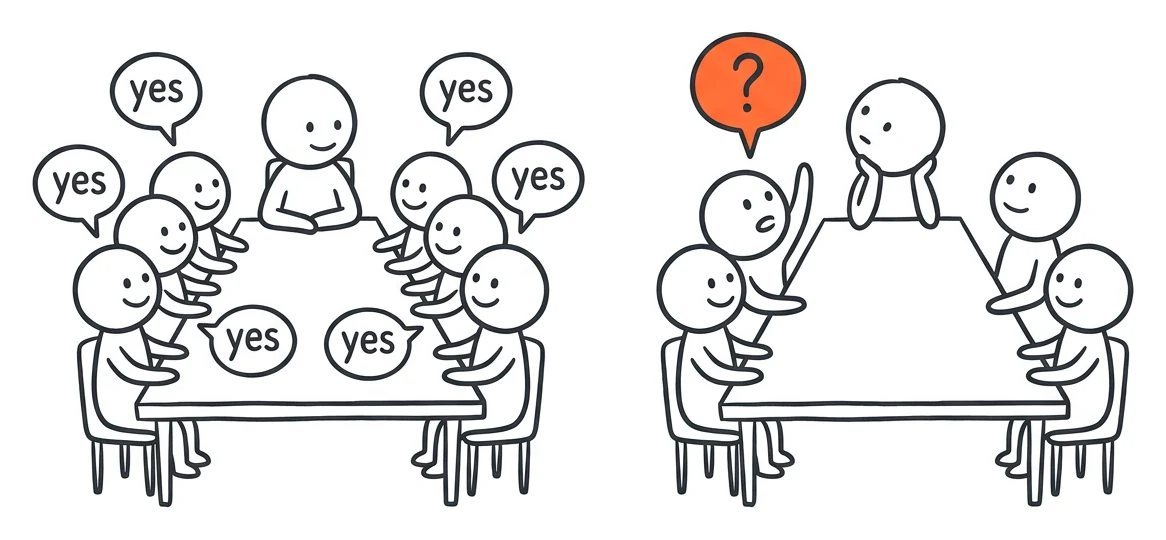
Two questions tell you which kind of leader you are.
When a decision comes up, do you already know what you'll do? Or will you listen to the expert and let the data show you whether it's working?
And once it's decided, will you micro-manage the task, or delegate it and actually become the leader?
These used to be questions of style. Now they set the company's capacity.
Fin Dittimi, who builds AI guardrails and compliance structures, said on the panel that "the creative act has now moved from producing it to actually selecting what is best." In his words, "the bottleneck has now moved from building to imagination and judgment."
Take that to the top of the company. A team can now bring a hundred takes and test them on a real audience. If the person selecting will only accept the one that was already in their head, the other ninety-nine were wasted work, and the whole company is limited to what one person could imagine.
The tools won't settle this for you. People complain that the models agree with everything. Juan Cabrera, who builds these tools with companies, pointed out on the same panel that "you can also instruct it to tell you that you're wrong." Most people never do.
A yes-man is a choice, whether you hire one or prompt for one.
So AI doesn't make a controlling CEO less controlling. The CEO who rewrote every deck will rewrite every output.
The ones who do let go don't end up with less authority. A leader now lives off the merit of their own direction, and handing off the execution is what leaves room for the higher decisions.
Two Functions Hold the Levers
The CEO sets the conditions. Two other functions hold the means to design what happens inside them.
HR holds performance management, pay, promotion and hiring. Those four decide what behavior the environment selects for. In most companies, HR is asked to administer them, not to design them.
Mahsa Rezaei gave an example on the panel. Companies have handed even their job descriptions to AI, nobody is responsible for what goes out, and then they can't find a good match.
A job description is the first design decision about a role. It decides who the company selects. When it goes out with nobody standing behind it, the model didn't take that decision from HR. Nobody held it in the first place.
Strategy has the same problem from the other side. Most companies have a strategy document, not a strategy function. The document says where the company is going. The function's job is to translate that into the environment.
Picture a strategy that calls for selling across business units, sitting on top of a bonus plan that pays each unit on its own number. People follow the bonus plan, and they're right to. The strategy was never built into anything they work inside.
Neither function can do this alone. HR has the levers and no say in the direction. Strategy has the direction and no levers.
It Just Got That Way
So who is building the environment? Everyone, one piece at a time.
Each divisional director builds their own: their headcount, their metrics, their rules for who gets ahead. It's empire building, and from where they sit it's rational. Each function optimizes for what it's measured on, which is how you end up with teams that aren't misaligned at all, just optimizing perfectly for different things.
Add those local designs together and you have the company's environment. Nobody chose it.
For a long time that was survivable. Change was slow, the environment just got that way, and a company had years to absorb the mismatch. The longer the same leadership team sat inside it, the more natural it looked.
That excuse is gone. Earlier this week I argued that how far an AI redesign can go depends on the mandate behind it. Who holds that mandate and who owns the environment are the same question.
A redesign that crosses three teams needs someone with authority over what all three are rewarded for. In an environment built by default, that person doesn't exist. Companies that leave it that way will fall far behind the ones that design it.
The design is a joint job. The CEO sets the conditions: hire people who will challenge you, let the data decide, delegate and lead. HR and strategy then design the environment and its incentives together, for the whole company and not division by division.
What goes into that design, the incentives themselves, deserves its own piece.
For now, look around your team and your organization. Are you designing the environment your people work in, or inheriting it? Then ask the same of your leadership team, HR and strategy. If none of you can say "I designed this," nobody did.
Next Friday: The Incentive Architecture.